Europe’s agricultural sector is entering a period of significant transition as digital technologies become part of everyday farm management and value-chain operations. This shift, originally driven by innovation, is now shaped by a developing regulatory and governance environment. New instruments such as the Data Act, the AI Act, the NIS2 Directive and the Cyber Resilience Act introduce clear rules on data access, system transparency and cybersecurity. Alongside these regulations, efforts such as the emerging Common European Agriculture Data Space (CEADS) aim to bring greater coherence to how agricultural data initiatives align across Europe by introducing shared governance and interoperability principles. Within AgriDataValue, the political and techno-socio-economic radar has been tracking these developments to understand their practical implications considering increasing operational demands.
Several dynamics stand out:
- A clearer legal foundation for data governance: The Data Act and its model contractual templates help standardise how agricultural data is shared, protected and used. Roles such as data holder, data user and data recipient are becoming more consistent across the sector.
- Rising expectations for trustworthy AI: The AI Act sets enforceable requirements for documentation, transparency and human oversight. This affects decision support tools used for agronomy, environmental monitoring and compliance.
- Cybersecurity as a core requirement: The Cyber Resilience Act and NIS2 make cybersecurity a legal obligation. This increases responsibility for farms, service providers and platforms operators that handle agricultural data.
- Environmental regulations that rely on accurate data: Instruments such as the EU Deforestation Regulation require geolocation accuracy and verifiable data links to Earth Observation sources. This raises the importance of consistent and high-quality data infrastructures.
- Social and organisational challenges that remain central: Concerns about fairness, ownership and skills continue to affect adoption. Many farmers need clearer benefits and more support before engaging fully with digital tools. Cooperative data models and human centric governance remain important in building trust.
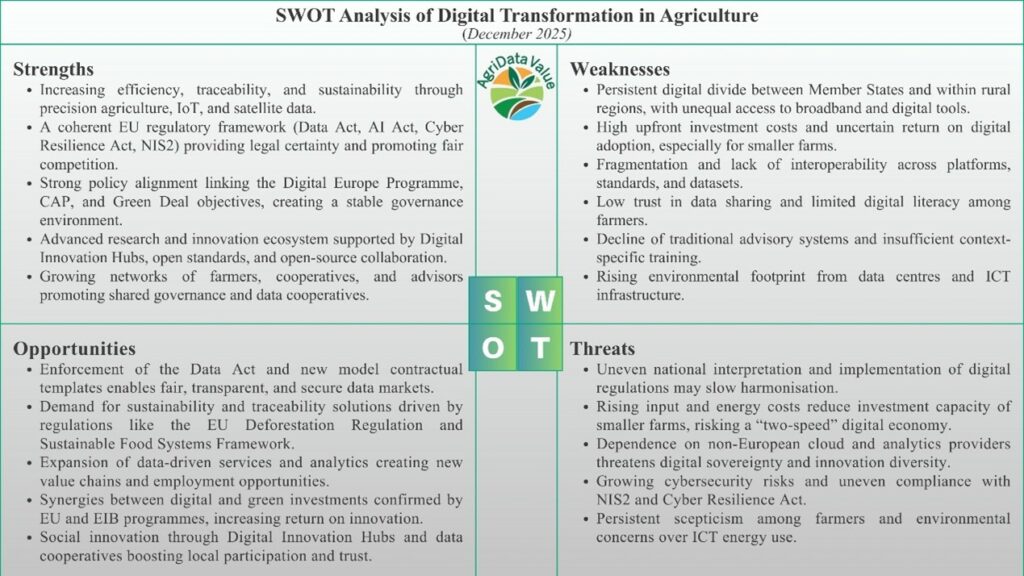
These trends are shaping the conditions in which digital agriculture will evolve. To summarise this landscape, AgriDataValue has prepared an updated SWOT analysis that captures the main strengths, weaknesses, opportunities and threats influencing adoption and value creation. The figure below presents these insights in a consolidated form and supports the project’s ongoing exploitation and sustainability planning.
As digital agriculture becomes more regulated, more interconnected and more dependent on reliable data, the sector must balance innovation with responsibility and efficiency with fairness. AgriDataValue will continue monitoring these developments and will translate them into practical solutions that support a trustworthy and inclusive agricultural data ecosystem.
Stay connected for future updates as this landscape continues to evolve.