

Climate stress is rapidly reshaping livestock production across Southern Europe, with Greece among the most exposed regions. Rising average temperatures, more frequent heatwaves, prolonged droughts and increasing water scarcity place significant pressure on animal health and welfare, particularly in sheep and goat systems that dominate Greek livestock farming. These systems are largely extensive or semi-extensive and therefore highly dependent on ambient environmental conditions rather than controlled indoor infrastructure.
Animal welfare is a key determinant of meat quality and the credibility of origin, sustainability and ethical production claims. Climate-related welfare impacts are often poorly documented, as fragmented records fail to capture real-time environmental exposure. Data-driven monitoring addresses this gap by continuously collecting environmental and livestock-related parameters, enabling traceability, certification and compliance with evolving European standards. Within this framework, AgriDataValue supports a European agri-environmental data space that integrates farm-level sensing, climate information and advanced analytics. Pilot systems applied in cattle farming use these data to identify risk patterns linked to heat stress, animal aggregation, shared water or manure handling and increased farm traffic, enabling early and targeted biosecurity interventions.
In Greece, recurrent outbreaks of sheeppox continue to pose a serious threat to meat-producing livestock systems, leading to movement restrictions, compulsory culling and significant economic losses, particularly in regions with dense small-ruminant populations. Although cattle are not susceptible to Capripoxvirus and do not develop sheep and goat pox, cattle farms can play an important preventive role at system level. This is especially relevant in Greece, where livestock systems often share infrastructure, resources and transport routes. During the twelve-month period preceding early 2025, official figures reported more than 2.400 confirmed cases and the culling of approximately 260.000 sheep and goats, representing around 2% of the national small-ruminant herd (https://www.reuters.com). These outbreaks are strongly linked to gaps in early detection, delayed reporting and limited real-time visibility of animal health and environmental stressors that may facilitate disease spread.
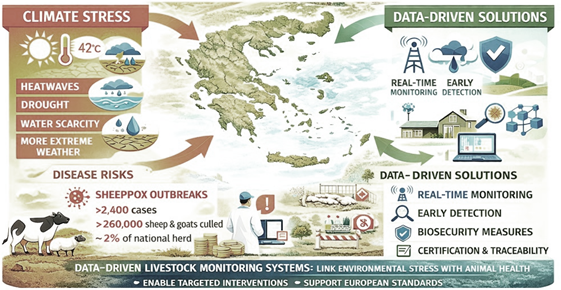
Data-driven pilot approaches developed within AgriDataValue, including pilots applied in cattle farming, combine environmental monitoring, animal-related data and interoperable data sharing. Although cattle are not susceptible to Capripoxvirus, data from cow pilots provide early warning signals linked to heat stress, animal aggregation, farm traffic and shared resources. By enabling early identification of abnormal patterns linked to heat stress, animal mobility and farm-level risk factors, such pilots support proactive disease surveillance, faster response mechanisms and targeted biosecurity measures. In this way, trusted data not only support animal welfare and stable meat quality but also contribute directly to preventing and mitigating infectious disease outbreaks in climate-stressed livestock systems.