The digital transformation of agriculture is no longer limited to collecting information from sensors, machinery, satellites, weather services and farm management systems. The real challenge is to transform heterogeneous data into trusted, interoperable and actionable knowledge that can support decisions in real agricultural environments. A previous AgriDataValue article presented the importance of agricultural data models and semantic interoperability, explaining how common standards allow information exchanged between different systems to retain a consistent meaning. Since then, the project has entered a more mature technological stage.
The focus is increasingly moving from defining how agricultural information should be represented to demonstrating how it can be securely exchanged, processed, analysed and validated across multiple pilot environments. The updated AgriDataSpace Reference Architecture strengthens the project’s technical foundation through closer alignment between the Agriculture Information Model and the IDS Information Model, improved security and data-protection mechanisms, and clearer infrastructure specifications for artificial intelligence, machine learning and federated learning. At the same time, the latest smart farming implementation and validation activities show how this technological foundation can be connected to practical agricultural challenges. Together, these developments demonstrate how AgriDataValue is evolving from an interoperability concept into an operational ecosystem for data-driven agriculture.
Moving beyond a single agricultural platform
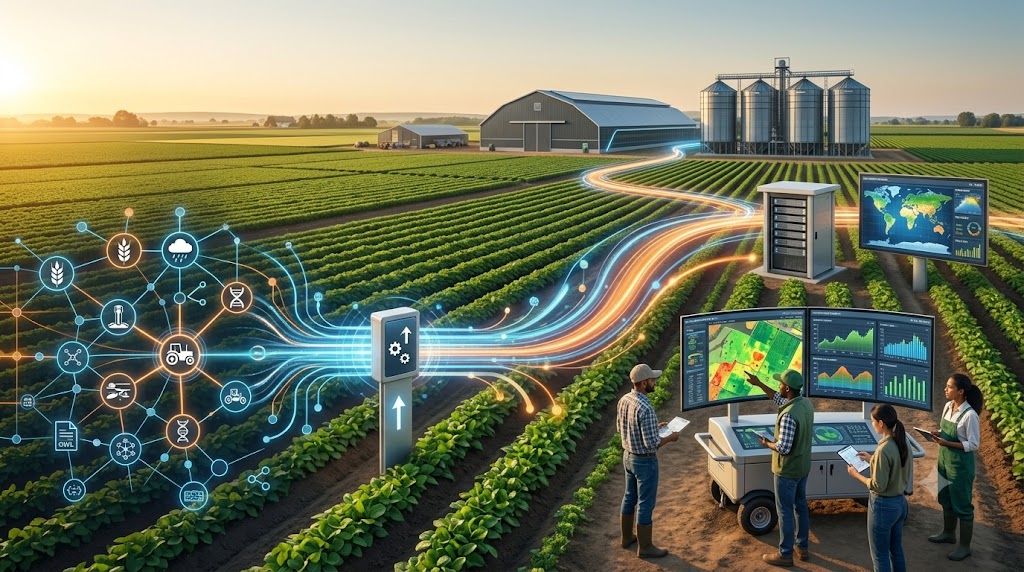
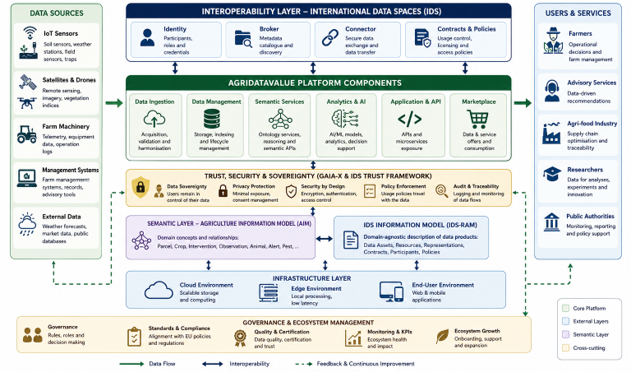
One of the most significant developments is the evolution of AgriDataValue as a platform of platforms, rather than as a single centralised application. Agricultural data is naturally decentralised. Information may be stored in local farm-management applications, sensor platforms, research infrastructures, public databases, regional services or equipment supplied by different manufacturers. Requiring every participant to transfer all information into one central system would create technical, organisational and trust-related barriers. The updated architecture addresses this challenge through a multi-instance approach. Different AgriDataValue environments can support local, regional, national or European ecosystems while remaining connected through common interoperability mechanisms. This allows the ecosystem to grow horizontally while giving local actors greater control over their own infrastructure and data. The International Data Spaces layer supports communication and trusted exchange between these environments. The Agriculture Information Model, or AIM, preserves the domain-specific meaning of agricultural information. The two models have complementary roles. AIM describes concepts such as parcels, crops, observations, interventions, animals and alerts. The IDS Information Model describes how the related data products can be published, discovered and exchanged, including information about participants, access conditions and usage policies. This separation ensures that agricultural meaning is preserved while datasets remain discoverable and interoperable across different platform instances and external systems. As illustrated in Figure 1, AgriDataValue connects heterogeneous agricultural data sources with semantic models, secure data-sharing mechanisms and AI-enabled services, transforming raw information into practical value for agricultural stakeholders.
Secure, sovereign and AI-ready data
Interoperability is not only about connecting technical systems. Agricultural data may contain commercially valuable or sensitive information about production, resources, farm operations and business performance. Trust is therefore a fundamental condition for participation in an agricultural data ecosystem. The updated architecture reinforces a security-by-design approach in which protection mechanisms are integrated throughout the platform. Authentication, authorisation, access control, secure communication and traceability help ensure that information is exchanged only between authorised participants.
Data providers can remain in control of their resources and define the conditions under which information may be accessed and used. This is particularly important for encouraging farmers, businesses and public organisations to participate in data-sharing initiatives without losing control over their data. The architecture also combines cloud and edge environments. Some information can be processed close to the farm, sensor or machine, where reduced latency or additional privacy is needed. More demanding activities, such as model training, large-scale analytics or cross-pilot services, can use cloud infrastructure.
This combination creates a stronger technical foundation for AI-enabled agricultural services. Irrigation recommendations, frost warnings, pest-risk indicators and livestock alerts need to be processed and communicated while intervention is still possible. A technically accurate prediction delivered too late may provide limited operational value. By connecting interoperable data exchange with cloud and edge processing, AgriDataValue creates the conditions needed to turn agricultural data into timely recommendations and decision support.
Connecting requirements, architecture and practical use
Within this technological evolution, AgriDataValue brings together user needs, technical requirements, platform architecture and validation activities. A complex digital ecosystem cannot be developed only from the perspective of individual technical components. It requires continuous collaboration between technology partners, pilot organisations, researchers and end users.
The updated architecture and technical requirements reflect this collaborative approach. Feedback collected during pilot preparation, integration activities and early testing is used to refine the platform and ensure that its capabilities remain connected to real agricultural needs. Requirements are treated as a living set rather than as a static document. They continue to evolve as integrations progress, users interact with the solutions and new technical or operational constraints become visible. This iterative process helps bridge the gap between the project’s technological vision and solutions that can be deployed, tested and evaluated in practice. It also ensures that technical developments remain aligned with the needs of farmers, advisers, researchers and public authorities.
From architecture to real agricultural use cases
The project’s pilot activities provide the strongest evidence of its transition towards operational maturity. AgriDataValue includes 23 pilot sites representing different agricultural sectors and geographical contexts across Europe. These pilots generate crop, livestock and environmental data that can support model development, system testing and use-case validation. The use cases address challenges such as smart irrigation, weed detection, greenhouse management, crop-development prediction, disease and pest forecasting, livestock welfare monitoring and supply-chain traceability. The latest implementation phase is no longer limited to installing sensors or identifying available datasets. It examines more closely how each use-case objective can be achieved through combinations of sensor measurements, observations, external data sources and analytical models. This transition is important for scalability. A solution creates greater value when it can be reused or adapted across several agricultural contexts rather than remaining connected to one pilot site.
The cross-pilot approach supports this objective by promoting common use-case definitions, technical guidelines, data flows and evaluation criteria. Pilot teams can exchange lessons learned and identify opportunities to transfer solutions while still adapting them to local environmental, regulatory and operational conditions. In this way, AgriDataValue moves from isolated technological demonstrations towards an ecosystem in which models, data and best practices can be compared, adapted and reused.
User-driven validation and measurable impact
A technically advanced system creates value only when people can understand and use it effectively. AgriDataValue therefore applies an iterative validation process based on continuous feedback from pilot partners and end users. The objective is not only to verify whether individual components function correctly, but also to determine whether the deployed solutions are useful, understandable and reliable in daily agricultural activities. The project’s evaluation framework combines two complementary dimensions.
Impact Assessment examines how a technological intervention changes farming practices, decision-making or operational results.
Quality Validation evaluates the quality of the deployed solution, including data quality, visualisation, usability, AI-model performance and overall system behaviour.
The evaluation is longitudinal, meaning that it takes place throughout the lifecycle of the pilot rather than only at the end. Feedback can therefore be used to identify issues, refine requirements and improve the solution during implementation. Traditional methods, including interviews, questionnaires and usability testing, are combined with technological evidence such as system logs and platform-usage data. This creates a stronger basis for understanding both how the technology performs and how it is perceived by users. This approach is essential for responsible agricultural innovation. A highly accurate model may still have limited practical value when its results are difficult to locate, interpret or apply. By integrating farmers, advisers and pilot organisations into the evaluation process, AgriDataValue treats usability and user experience as essential parts of technical quality. The feedback collected during pilot implementation can also support scale-up. Lessons learned in one environment may inform improvements in another, reducing duplication and helping successful solutions reach a wider group of users.
Conclusion
AgriDataValue’s progress demonstrates that the future of digital agriculture depends on more than collecting larger volumes of information. Value emerges when data can be understood, trusted, securely exchanged and transformed into timely decisions. The updated reference architecture provides a scalable and interoperable foundation for a distributed agricultural data ecosystem. Its combination of semantic models, trusted data-space technologies, cloud and edge infrastructure and AI-ready processing supports the transition from raw information to practical agricultural intelligence. The pilot activities demonstrate how this foundation can be applied to real challenges, while the evaluation framework ensures that success is measured not only through technical indicators, but also through usability, impact and continuous improvement. By aligning technical requirements, architecture, pilot implementation and user validation, AgriDataValue supports the transition from an ambitious technological vision to an operational and measurable agricultural data ecosystem. The next challenge is no longer simply to demonstrate that agricultural systems can exchange information. It is to ensure that this exchange consistently produces knowledge that farmers, researchers, businesses and public authorities can trust and use.
References
- AgriDataValue Consortium. Deliverable D1.4 – AgriDataSpace Reference Architecture Update. Version 1.0, 2025.
- AgriDataValue Consortium. Deliverable D3.6 – Smart Farming Use Cases Implementation & Validation V2. Version 1.0, 2026.
- AgriDataValue. Enhancing Agricultural Data Models and Semantic Interoperability. 17 March 2025.
- International Data Spaces Association. International Data Spaces Reference Architecture Model – IDS-RAM.
- DEMETER Project. Agriculture Information Model – AIM.
- GAIA-X European Association for Data and Cloud. GAIA-X Trust Framework.