Across Europe, initiatives around the Common European Agricultural Data Space are pushing for a future in which agricultural data can move securely between farmers, cooperatives, service providers and public authorities, under clear rules and shared governance frameworks [1][2]. AgriDataValue (ADV) contributes to this vision by developing a “platform of platforms” for smart farming and agri-environmental monitoring, where security and transparency are not just requirements on paper but are designed into the architecture and exercised in pilots [3][4].
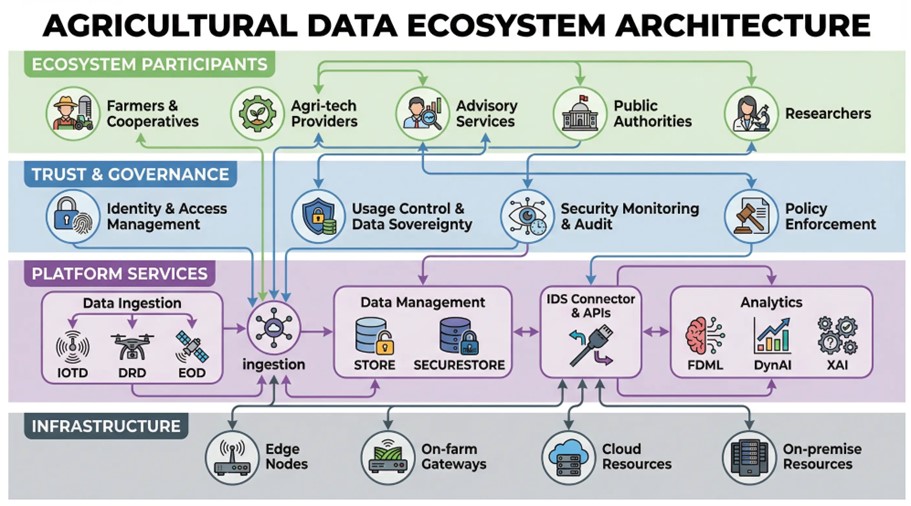
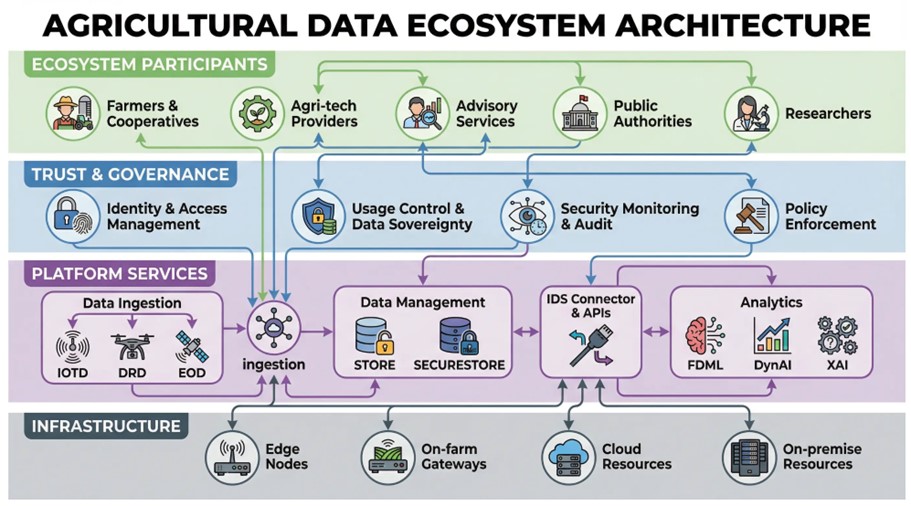
The starting point is simple: without trust, there is no data sharing. Agricultural data is often commercially and personally sensitive, from yield maps and input usage to compliance and environmental indicators. Actors will only share this information if they know who can access it, for which purpose and under which guarantees. This is why the latest AgriDataValue reference architecture treats security, transparency and accountability as cross-cutting concerns that influence every component and interface, from IoT gateways and edge nodes to cloud services and data-space connectors.
Security controls in practice
In practice, human users and services authenticate against a trusted identity provider, and internal as well as external communication uses token-based authorisation, following patterns that are widely adopted in secure web and API architectures [5][6]. Access to datasets and services is governed by a combination of role-based and attribute-based access control, so that permissions can take into account not only who is asking, but also properties of the data, such as whether it contains personal information or commercially sensitive indicators, and the applicable legal or contractual constraints. These choices are aligned with data-space concepts such as data sovereignty and usage control, where policies describe not just whether data can be accessed, but also under which obligations and for which purposes [5][6].
At the technical level, the platform enforces end-to-end protection. Traffic between components is secured via TLS, while sensitive data at rest is encrypted using well-known algorithms. API gateways validate requests, apply rate-limiting and record security-relevant events. Logging and monitoring are treated as built-in capabilities: authorised stakeholders can see, at a metadata level, which connectors are active, which policies have been evaluated and whether access requests have been granted or denied, without exposing the underlying data itself. This combination of secure communication, strong identity and fine-grained authorisation turns high-level trust requirements into concrete controls that can be tested in pilots [3][4].
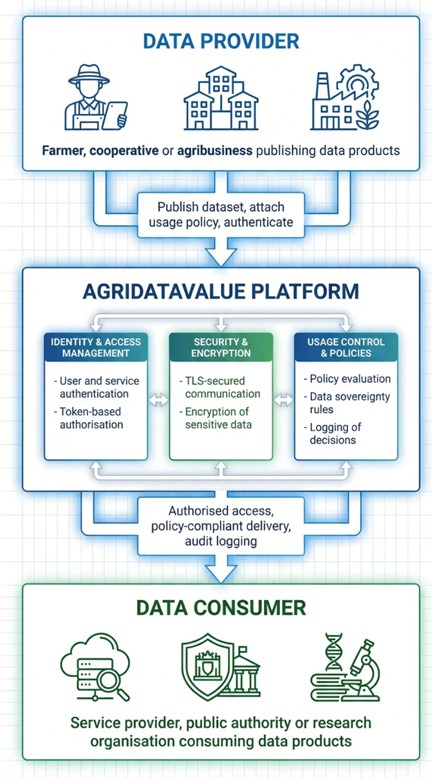
Transparency and accountability
Transparency is the other side of the trust equation. For many stakeholders, the important questions are not only whether data is protected, but also what happens to it once it enters the platform and whether it is possible to demonstrate that agreed policies have been followed. To address this, the AgriDataValue architecture emphasises location transparency with compliance guarantees: users and applications interact with platform services without needing to know where the data is physically stored or processed, while the system still respects data-residency rules and GDPR obligations [1][2].
Data-flow visibility is enabled through dedicated monitoring and auditing capabilities. Within their authorised scope, data providers can inspect how their data assets are routed between edge nodes, cloud components and external connectors. Logs record key events along the data-sharing journey, from publication and policy attachment to access evaluation and delivery to consumers. This supports accountability and helps participants demonstrate compliance with governance rules defined at project or ecosystem level. In pilots, these features are exercised with real IoT streams, Earth observation products and farm management data, showing how trust mechanisms behave under realistic conditions rather than only in synthetic test cases [3][4].
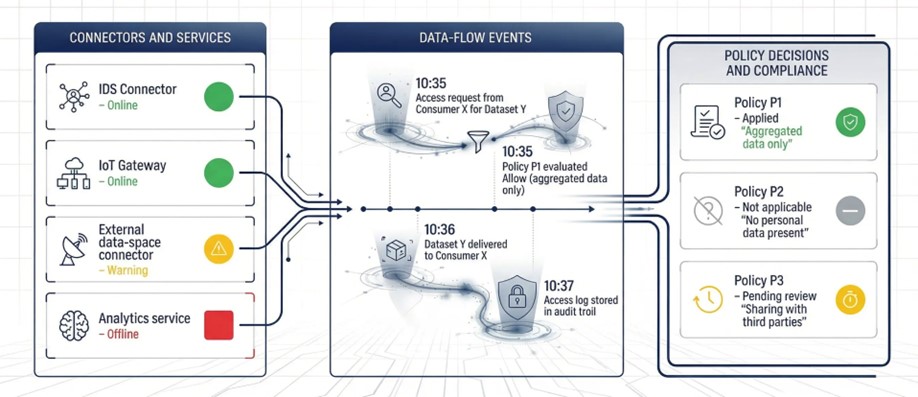
Alignment with European frameworks for data spaces
The design choices in AgriDataValue build on established European reference models and frameworks for data spaces. The International Data Spaces Reference Architecture Model (IDS-RAM) provides a detailed blueprint for trusted data exchange, including identity management, secure connectors and usage-control enforcement [5]. Gaia-X, through its Trust Framework, defines baseline criteria and evidence for participants in federated European data ecosystems, focusing on transparency, controllability and interoperability [6]. In parallel, the European strategy for data and the Data Governance Act set out the principles and regulatory context for sectoral data spaces such as agriculture [1][2].
The AgriDataValue architecture adopts and adapts these ideas when defining its interfaces, policy models and governance functions, so that individual platform instances can plug into the emerging agricultural data-space landscape rather than forming isolated silos. Concepts such as usage policies, verifiable identities and auditable connectors are therefore not only referenced in documentation, but also reflected in the APIs and deployment models that are exercised across the project’s pilots [3][4][6].
Insights from research on trusted agri-data spaces
Academic work on smart farming and agricultural data spaces reinforces the importance of combining security, transparency and governance. Studies on the ethics of smart farming underline that unclear ownership, opaque data flows and weak usage policies can seriously undermine farmers’ willingness to share data and adopt digital tools [7]. Analyses of blockchain and distributed-ledger applications in agri-food supply chains show that traceability and verifiable logging can improve trust, but only when they are embedded in broader governance frameworks and aligned with real stakeholder needs [8].
These insights are reflected in AgriDataValue’s approach: policies are made explicit and, where possible, machine-readable; key events in the data life cycle are traceable; and technical controls are designed to be usable in day-to-day operations rather than remaining as abstract architectural patterns. In this way, requirements coming from policy documents, reference architectures and research are translated into mechanisms that can actually support data sharing in concrete agricultural scenarios.
Conclusions
By combining requirements from European policy, architectural guidance from IDS and Gaia-X and lessons learned from pilots and research, AgriDataValue offers a concrete example of how “trusted agricultural data spaces” can move from concept to implementation. Security mechanisms such as strong identity management, encryption and fine-grained access control, together with transparency features like monitoring, auditing and policy-aware data flows, make it possible to answer key questions about who can access which data, under which rules, with which guarantees and how this can be demonstrated over time.
As the Common European Agricultural Data Space evolves, these building blocks can be reused, extended and federated. The result is an ecosystem in which data sharing in agriculture is not only technically feasible, but also trustworthy for all participants, supporting innovation while respecting data sovereignty, legal obligations and the legitimate expectations of farmers and other stakeholders.
References
[1] European strategy for data
Communication “A European strategy for data”, COM(2020) 66 final, 2020 – EUR-Lex
- Link: https://eur-lex.europa.eu/legal-content/EN/TXT/?uri=CELEX:52020DC0066 Eur-Lex+1
[2] Data Governance Act
Proposal for a Regulation on European data governance (Data Governance Act), COM(2020) 767 final – EUR-Lex
- Link: https://eur-lex.europa.eu/legal-content/EN/TXT/?uri=CELEX:52020PC0767 Eur-Lex+1
[3] AgriDataValue project
Smart Farm and Agri-environmental Big Data Space – CORDIS project page
[4] AgriDataSpace / CEADS context
AgriDataSpace – “Building a European framework for the secure and trusted data space for agriculture”
Dacă vrei explicit CEADS în lista de referințe:
CEADS – Common European Agricultural Data Space project site
[5] IDS Reference Architecture Model 4.0
International Data Spaces Association – IDS-RAM 4.0 (PDF)
- Link direct PDF: https://internationaldataspaces.org/wp-content/uploads/dlm_uploads/IDSA-Tech-Talk-IDS-RAM.pdf International Data Spaces+1
[6] Gaia-X Trust Framework
Gaia-X Trust Framework (latest public spec)
- Link (intro / spec PDF): https://gaia-x.eu/wp-content/uploads/2024/05/An-Introduction-to-the-Gaia-X-Trust-Framework_2024-V4.pdf gaia-x.eu+1
[7] Ethics of smart farming
van der Burg, S., Bogaardt, M.-J., Wolfert, S. (2019), “Ethics of smart farming: current questions and directions for responsible innovation towards the future”, NJAS – Wageningen Journal of Life Sciences.
[8] Blockchain in agriculture & food chains
Kamilaris, A., Fonts, A., Prenafeta-Boldú, F.X. (2019), “The rise of blockchain technology in agriculture and food supply chains”, Trends in Food Science & Technology.