Introduction
In today’s digital landscape, increasing trust in the use of digital assets is a fundamental goal, essential for their widespread adoption and utilization. In this context, organizations—and not only them—are increasingly relying on data and Artificial Intelligence (AI) models to make decisions in more critical sectors such as healthcare, finance, industrial and agricultural planning. Data is the essential fuel powering modern AI systems, and there is a growing demand for large volumes of “quality” data—data that accurately represents the reality being modeled and is free from internal biases.
This dependency raises a crucial question: how can we ensure that an AI model and the data it relies on are authentic? One technology that can help address this challenge, and has steadily matured over the years, is Blockchain.
Why Blockchain Matters
Blockchain is a distributed ledger that stores information in a way that makes it immutable and verifiable, without requiring a centralized certification authority. Each piece of information (or set of information) is recorded in a “block,” which contains the data along with a cryptographic link, a fingerprint of the previous block, creating an ever-growing structure inherently resistant to tampering. Once recorded, data remains permanently and immutably on the Blockchain. This immutability, combined with decentralization—where no central authority controls the system, makes Blockchain a reliable foundation for digital integrity.
Blockchain-Based Notarization
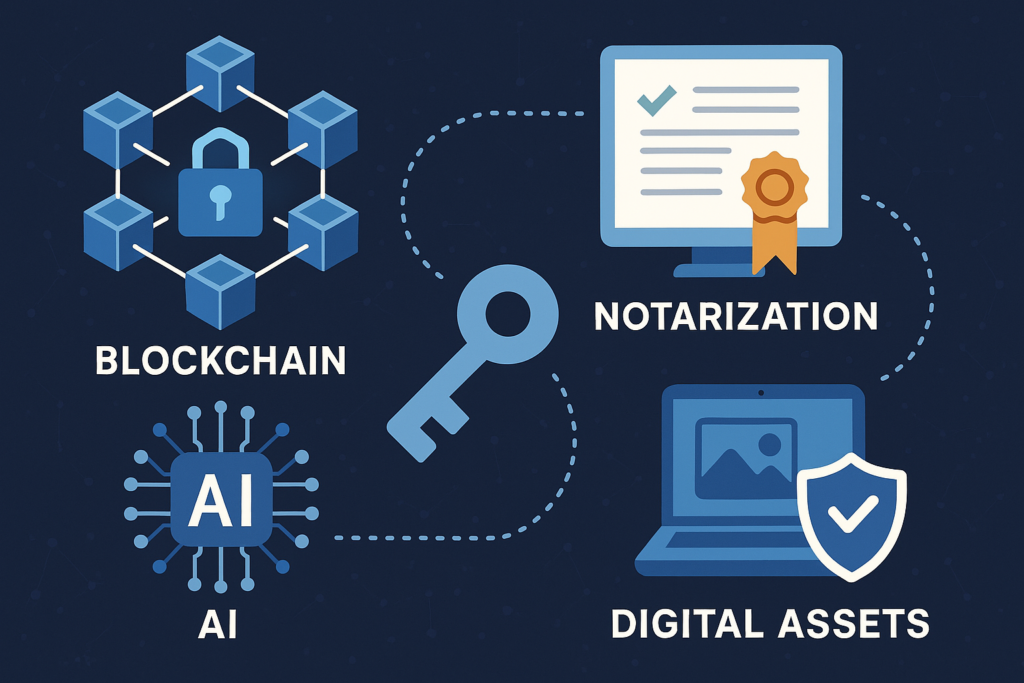
Within the platform developed by the AgriDataValue project, a Blockchain and a dedicated component called CHAINTRACK have been implemented to leverage these capabilities and offer advanced functionalities to users. One of these is Blockchain Notarization—a process that certifies that a digital asset exists in a specific form at a precise moment in time. This is achieved by computing a cryptographic hash of the asset—a kind of digital fingerprint—and recording it on the Blockchain. The hash does not reveal the asset’s content but allows anyone to verify its authenticity later. If the asset changes, its fingerprint (hash) changes as well, and any comparison with the hash stored on the Blockchain immediately reveals any alteration. Blockchain thus acts as a digital notary, guaranteeing authenticity without the need for centralized authority.
Notarizing an AI Model
The concept of notarization has been applied by the AgriDataValue consortium to AI model governance. These models are increasingly used in critical systems, making integrity assurance more important than ever. Within the AgriDataValue platform, once an AI model is created, trained and registered in a particular storage repository, the system automatically computes its hash and records it on the Blockchain using CHAINTRACK’s functionalities. This creates an immutable audit trail. Later, to verify that an AI model is authentic, one simply computes its hash and uses another CHAINTRACK feature to check if it exists on the Blockchain. The key benefits of this approach include:
- Real-time authenticity verification of AI models, enabling the blocking of unauthorized modifications and reducing security risks.
- Intellectual property protection, providing undeniable proof of ownership.
- Regulatory compliance, such as with the European AI Act, which requires transparency and traceability.
Any Digital Asset
The same notarization principle has been generalized within AgriDataValue to apply to any critical digital resource where authenticity verification is important. Examples include commercial agreements between partners and data governance policies. More broadly, legal contracts, intellectual property documents, product certifications, and compliance reports can all be protected in the same way.
Going further
We conclude this article with a potential extension of the current use of AI model notarization within AgriDataValue. One possible step in this direction is to extend notarization to the entire AI development lifecycle. This means notarizing not only the final model but also its architecture, all training and testing data, and performance and reliability scores achieved after training. Model, data, performance—all rendered immutable and verifiable through Blockchain notarization.
Having complete traceability of the entire AI production process significantly enhances reliability, compliance, and auditability. Certifying that a model was trained with specific data also reduces risks related to data integrity and potential bias introduced by poisoned training datasets. Finally, intellectual property protection is strengthened, safeguarding both models and data assets.
In general, extending notarization to every phase of AI development builds a solid framework of trust and accountability, a crucial step toward broader adoption of Responsible AI principles, fostering trust in AI usage and driving its diffusion and competitiveness.