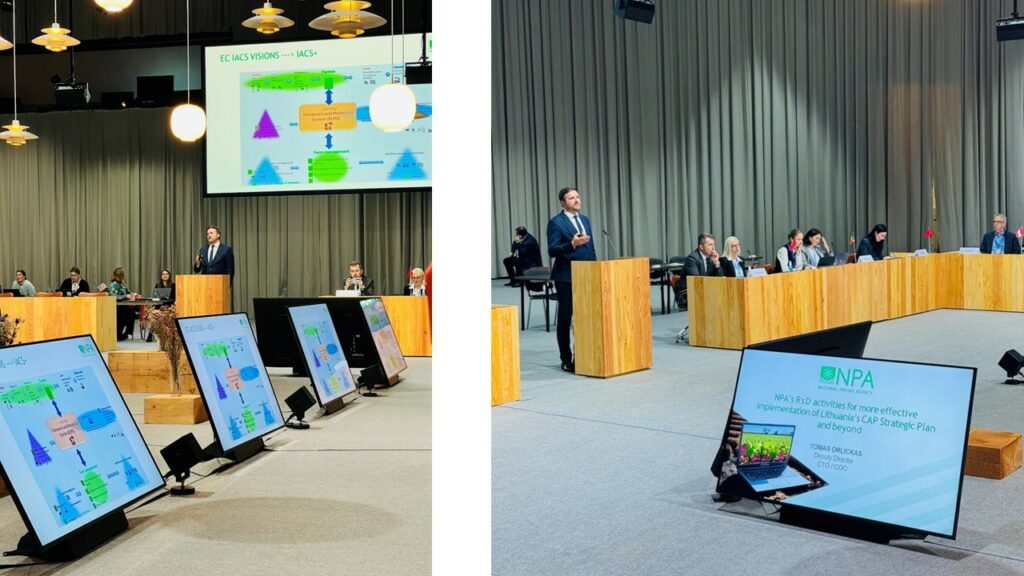
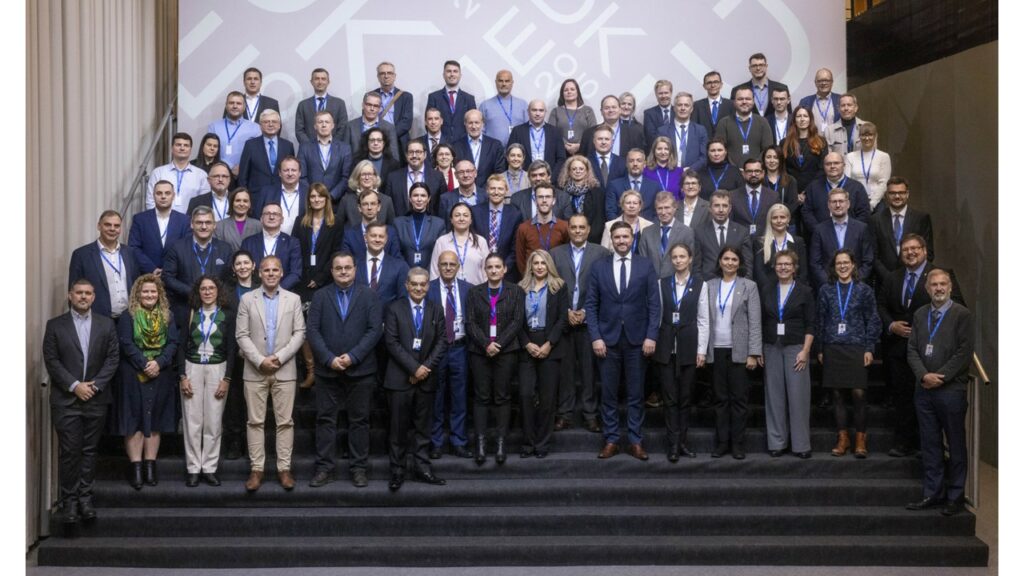
The 58th Conference of EU Paying Agencies Directors took place in Copenhagen, Denmark, on 19–21 November 2025, bringing together the EU Paying Agencies‘ senior representatives to discuss innovation, simplification, data governance, and the evolving role of AI in implementing the Common Agricultural Policy (CAP) as well as the future direction of the CAP development, with a strong focus on interoperability, AI applications, and green transition. The representative of the Lithuanian National Paying Agency (NPA) – Deputy Director Tomas Orlickas – took part in the event and familiarised the audience with the NPA achievements in carrying out the multiple objectives of the CAP in Lithuania.
The sessions of the 58th Conference of EU Paying Agencies’ Directorsfocused on several key themes, including:
• -The use of AI in the administration of support schemes;
• -Administrative simplification and improved institutional efficiency;
• -Modernisation of processes and advancing the green transition in the agricultural sector.
Over three days the delegates engaged in high-level presentations, thematic workshops, pitches and exchanges on best practices – particularly on AI applications, administrative simplification, aerial monitoring, and performance audit findings.
During the conference a key intervention was made by Tomas Orlickas, Deputy Director of the National Paying Agency (NPA) of Lithuania: “Research and development activities for more effective implementation of Lithuania’s CAP Strategic Plan” In his presentation, Tomas Orlickas highlighted Lithuania’s comprehensive contribution to the EU-funded research, development, and innovation initiatives designed to strengthen the implementation of the CAP Strategic Plan and support the transition towards a more sustainable, modern, and data-driven agricultural sector. The Deputy Director presented Lithuania’s ongoing research and innovation initiatives aimed at improving the efficiency, accuracy, and strategic coherence of the country’s CAP Strategic Plan implementation.
The Deputy Director also pointed out that the NPA’s Research & Development activities are closely aligned with EU priorities for digital transformation, environmental performance, transparency, and administrative efficiency. Tomas Orlickas outlined the importance of environmental monitoring, modelling of agricultural practices and tools that help measure biodiversity, carbon impacts and land-use changes, that are essential for delivering the green architecture of CAP. The showcased key initiatives included a number of projects with a focus on AgriDataValue being among them.
The Horizon Europe AgriDataValue project focuses on accelerating agriculture’s digital transformation and improving agri-environmental monitoring by developing a decentralized smart-farming data ecosystem. The project’s work includes:
- -Harnessing big data to enhance productivity, strengthen environmental performance, and support fair and stable income for farmers.
- -Creating tools for area monitoring, sensor-based data collection, and observation of climate and land-use changes (e.g., soil moisture, erosion, crop damage, yield estimations), as well as automated crop and object classification from geotagged images.
- -Connecting with, or aligning to existing satellite and remote-sensing infrastructures such as Sentinel, along with other Horizon initiatives.
The project will establish a pan-European, open-source agricultural data space that advances smart farming and environmental monitoring through a novel “platform of platforms.” Key expected outcomes include a fully operational federated platform enabling secure data sharing, new data-driven business models, trustworthy AI solutions using federated machine learning, and extensive pilot trials across nine EU countries to validate the tools in practice. Ultimately, the project will provide farmers with access to a far broader and richer set of data resources, supporting a faster and more seamless shift toward smart agriculture.
The presentation was followed by a Q&A session, allowing other Paying Agencies to explore how similar innovation-focused approaches could strengthen CAP implementation across the EU.
Overall, the conference underscored a shared commitment among EU Paying Agencies to modernisation, interoperability and innovation, setting the stage for enhanced collaboration.