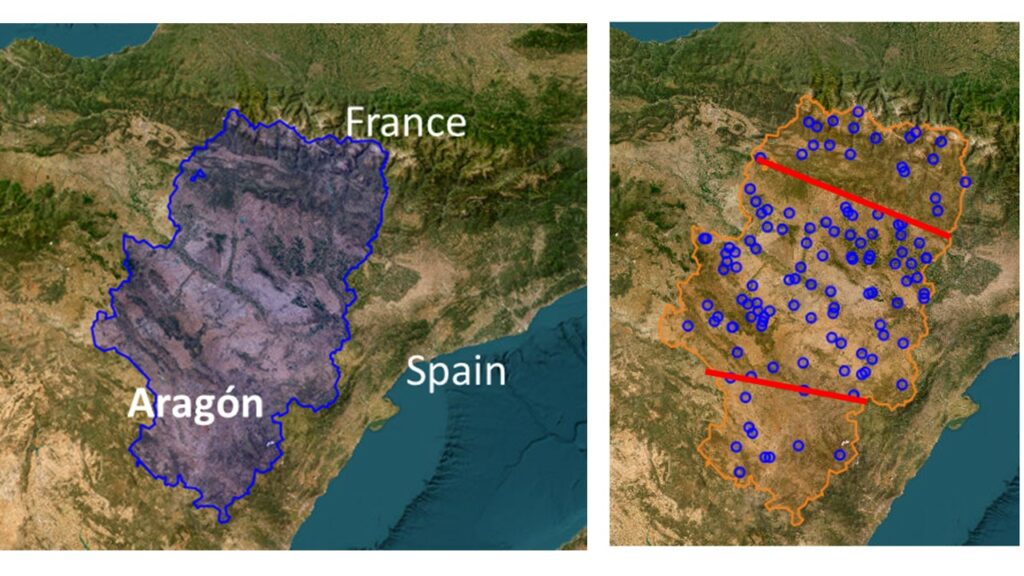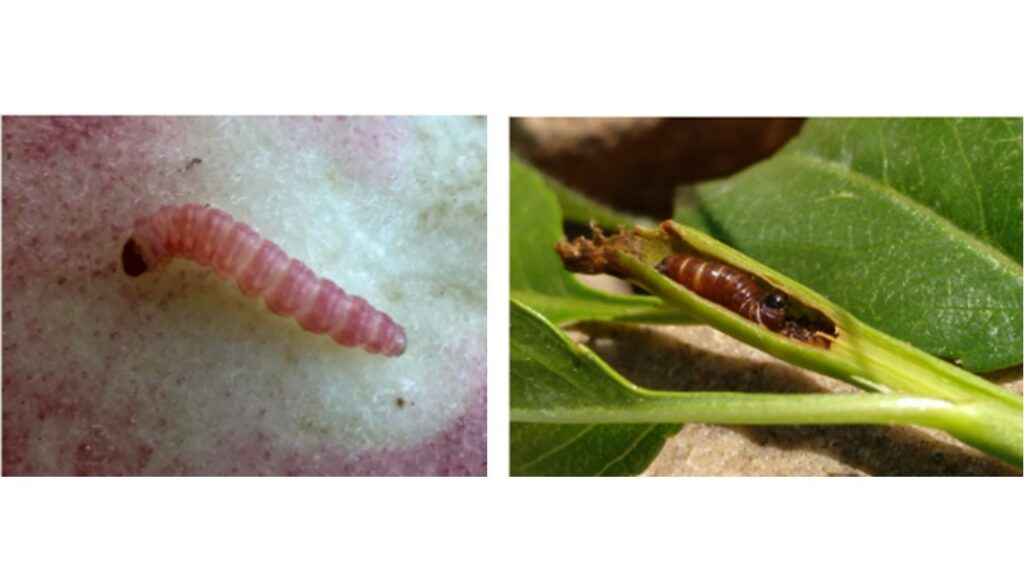

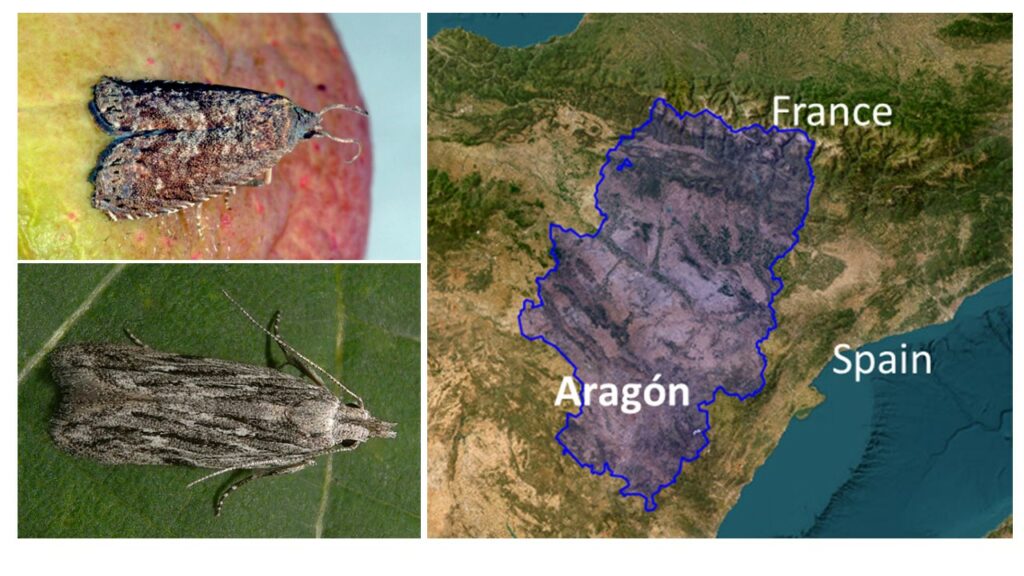
Phytosanitary treatments, to achieve maximum effectiveness, must be applied at specific phenological stages of the trees.
The following table provides a brief summary of the relationship between the phenological moments when treatments should be applied in stone and pome fruit trees, along with the degree‑days (°D) required for Anarsia lineatella and Grapholita molesta, calculated from the following biofix points:
• Anarsia lineatella: first male captured consistently in traps.
• Grapholita molesta: first consistent peak in traps.
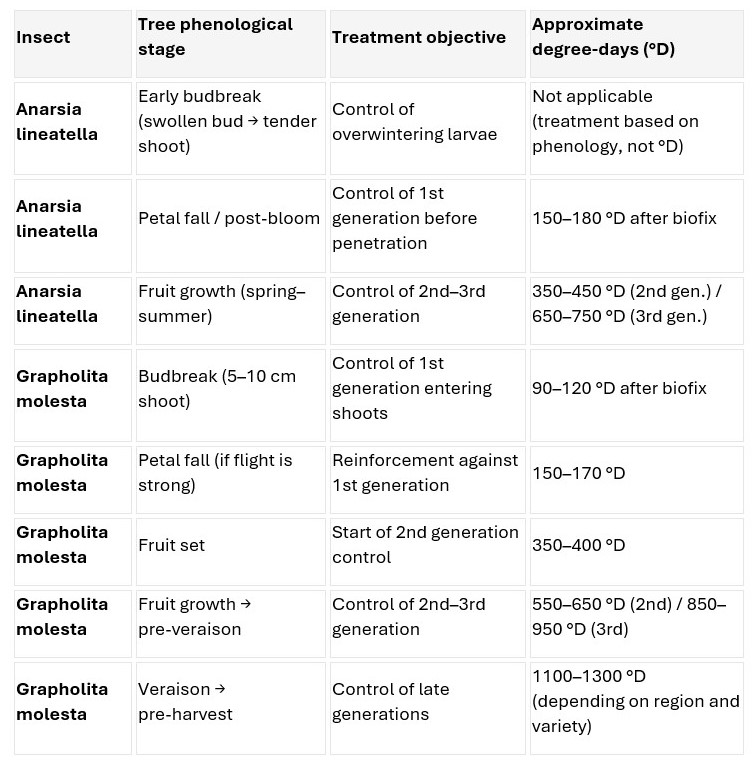
For Anarsia, the first treatment is determined mainly by the crop’s phenology, since the overwintering larvae attack tender shoots at the beginning of the cycle, and this moment is not well described by degree‑days. However, later generations do show a good thermal correlation: the first generation usually coincides with approximately 150–180 °D, the second with 350–450 °D, and the third with 650–750 °D, which allows for more precise scheduling of interventions throughout the season.
For the oriental fruit moth (Grapholita molesta), development depends much more on thermal models than on phenology, making degree‑days an essential tool for correctly timing treatments. Key thresholds begin at 90–120 °D, when damage to young shoots typically starts, and exceed 350 °D when the risk of significant fruit damage increases. These thermal milestones make it possible to anticipate generational development and adjust interventions more effectively.
The availability of models capable of predicting when specific phenological stages will be reached, and how the pests will develop, is therefore essential for carrying out effective phytosanitary treatments, contributing to a reduction in the use of such products and, consequently, to the sustainability of agricultural operations.
Traditional models for phenology prediction (GDD, Winkler, Richardson, etc.) and disease‑risk models are based on calibrating formulas that link temperature to the development of plants and pests. While calibration can be done relatively easily for a field with a local weather station, it becomes much more complex when, as in AgriDataValue Pilot 12: Non‑Citrus Fruit Trees, the goal is to model an entire region (Aragón, in northeastern Spain). In such cases, manual calibration is practically impossible. This is where the capabilities of Big Data and Artificial Intelligence (AI)—particularly Machine Learning (ML)—become crucial: these technologies can perform an enormous number of calculations in a time frame unthinkable for humans, and they can learn from their errors.
Furthermore, these techniques allow for the use of many more data sources: ML‑based models can incorporate additional variables. This enables the models to find relationships that, whether due to limited computational capacity or lack of knowledge, are not considered in current models based primarily on temperature—although temperature is known to be the most influential variable, it is not the only one.
For the development of the ML models, data from 49 public meteorological stations located near the selected fruit orchards are being used. Field observations—phenology and pest presence—are obtained from Red FARA, an application of the Plant Health and Certification Center of the Government of Aragón, responsible for issuing regional phytosanitary advisories, which for woody crops cover 160.000 ha. Additionally, although their relevance is limited, images from Copernicus Sentinel‑2 are included. This restricts the time period considered: data from 2016 to 2025 have been used to train the initial models.
These models represent, to some extent, a general model for Aragón that can be specialized for specific zones or orchards within the region. This will allow the consortium to test the Federated Learning capabilities of the AgriDataValue data space.
The results of the models are made available as services to be used by the CSCV, more than 2000 users, and by anyone interested in applying them in Aragón. In addition, the dataset on which they are based will be published as an outcome of the AgriDataValue project.