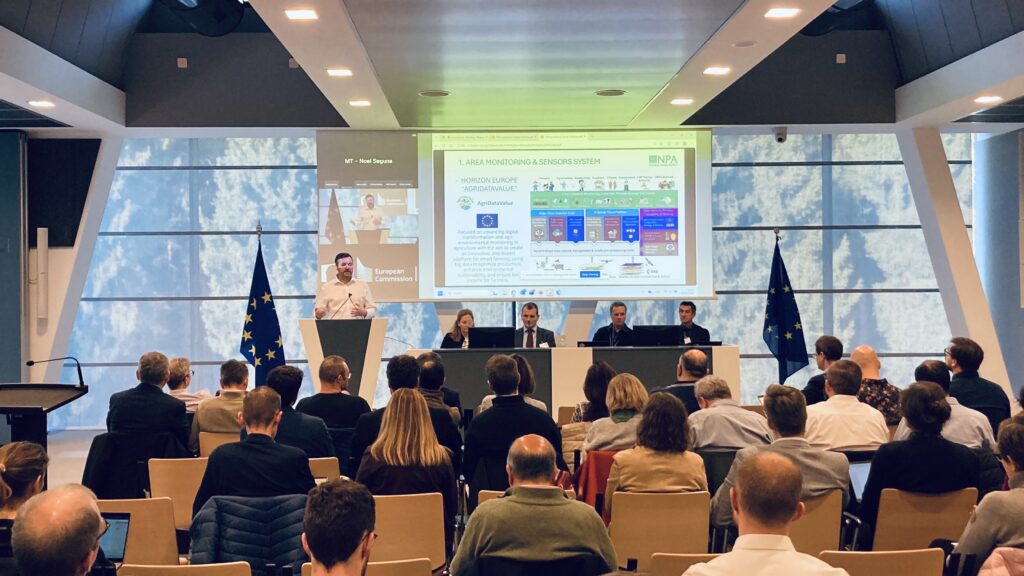
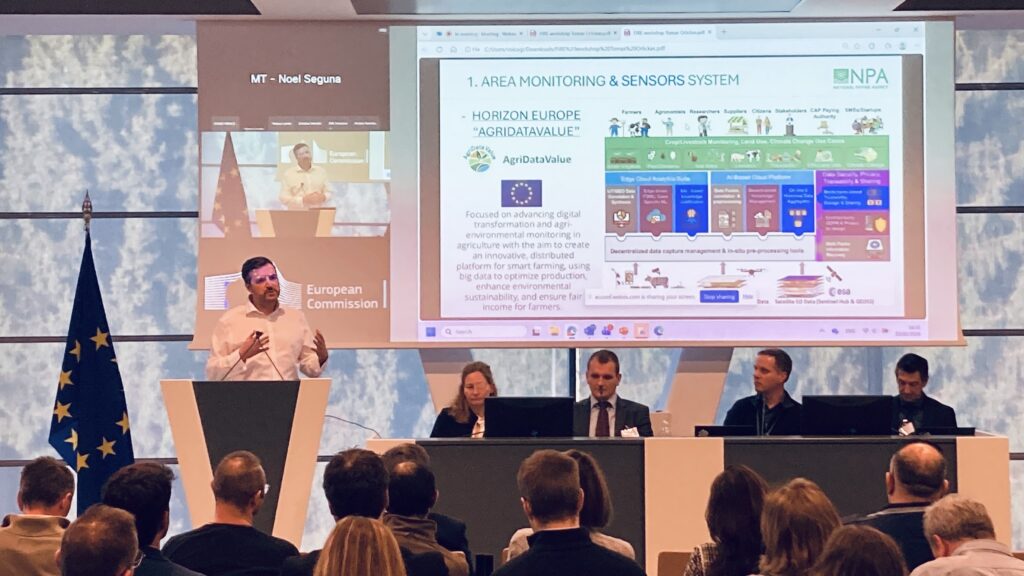
On 25–26 February 2026, the Joint Research Centre (JRC) organised the 2nd FIRE Workshop in Ispra, Italy, bringing together representatives from the European Commission, Member States and partner organisations to discuss the implementation of regulatory elements in agricultural monitoring. The workshop provided an important forum for exchanging experience on the Area Monitoring System (AMS), land parcel identification system (LPIS), and new technologies supporting the implementation of the Common Agricultural Policy (CAP). Tomas Orlickas, the Deputy Director of the National Paying Agency, Lithuania (NPA), familiarised the audience with the innovative AMS solutions and cutting-edge approaches by sharing the insights from NPA‘s participation in the international projects.
The workshop opened with remarks from JRC and DG AGRI representatives, setting the context for two days of discussion on both current challenges and future opportunities. A key message of the event was that effective agricultural monitoring increasingly depends not only on technical capacity, but also on cooperation between institutions, countries and research networks.
The discussions focused on AMS implementation challenges and possible solutions, reviewing survey results and highlighting current difficulties in monitoring. Presentations covered practical approaches such as the Dutch experience, outlier detection in Sentinel time series, and crop detection models designed to improve AMS performance. Further presentations explored the use of LPIS and GSA data, AI-supported updates of aerial imagery, and continuous updates of the Land Parcel Identification System with geotagged information. The day ended with a forward-looking session on the next CAP period and innovative monitoring tools.
Tomas Orlickas, Deputy Director of the National Paying Agency (Lithuania), presented “What’s Next after AMS? Strategy of Lithuania post-2027”, focusing on future developments in agricultural monitoring systems. He highlighted the growing role of international projects within this domain, showcasing Horizon Europe (HE), Horizon 2020 projects and other EU initiatives, as as well as national and EU-funded platforms that support data-driven agriculture. His presentation demonstrated how these collaborative projects contribute to advancing monitoring capabilities, including climate and environmental assessment, biodiversity tracking, and carbon accounting systems, thereby reinforcing the importance of international cooperation in shaping the next generation of agricultural monitoring tools. In the presentation the Horizon Europe project AgriDataValue was defined as an example of a “platform of platforms”, demonstrating how multiple data sources and digital tools can be integrated into a unified ecosystem. By combining satellite data, sensor information and farm-level inputs, the project supports smarter decision-making in agriculture, enhances environmental monitoring and promotes more efficient and sustainable farming practices. The project benefits farmers by providing integrated data tools that improve decision-making, optimise resource use, and enhance productivity while reducing environmental impact.
During the workshop the discussions also covered support to candidate countries and LPIS creation, followed by rapid-fire presentations on tools related to crop phenology, farming practices, vegetation dynamics, parcel viewing, image occurrence estimates and farm fragmentation analysis. Drone technology was another important topic, with presentations on the Czech use case and JRC field tests showing how drones can complement satellite-based monitoring with more detailed and flexible observations.