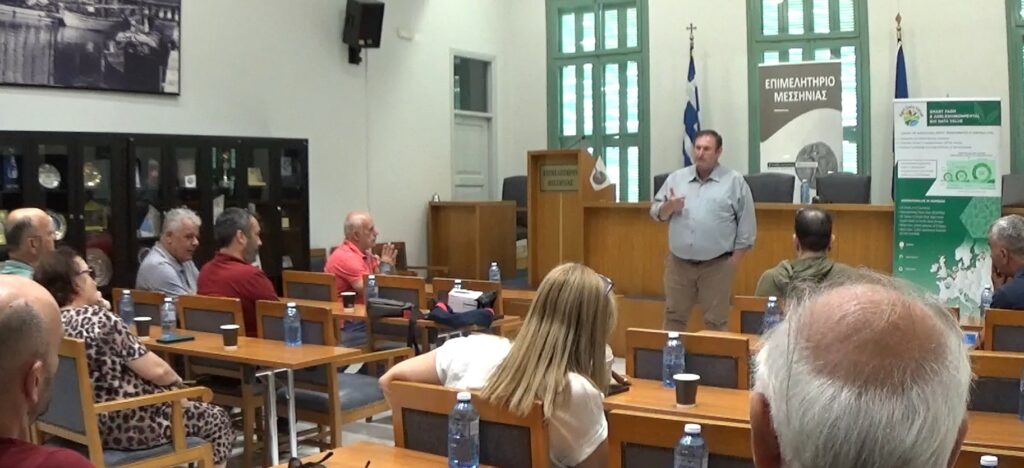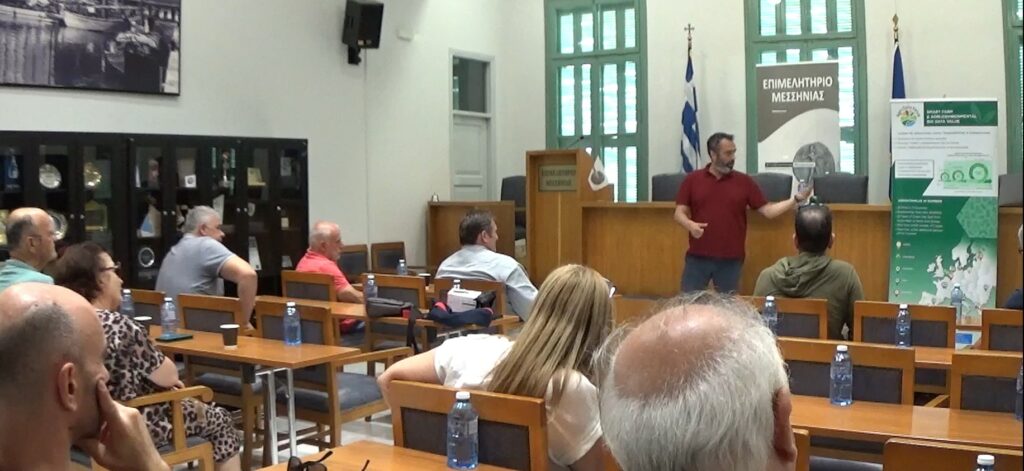

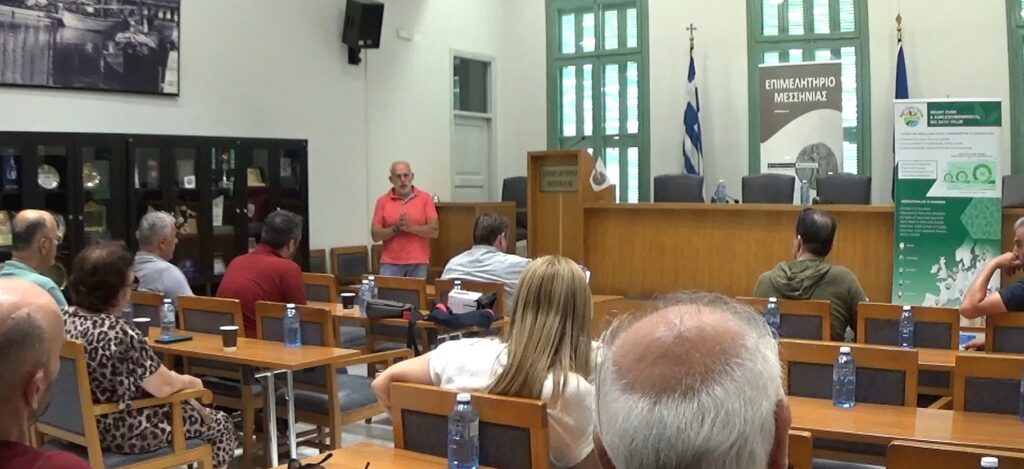
On Wednesday, 17 June, NILEAS organised a workshop on Use Case 3.4 “Pest control on olive fruit fly” at the Messinian Chamber of Commerce and Industry as part of the AgriDataValue project (Horizon Europe).
The workshop focused on the management of the olive fruit fly (Bactrocera oleae), one of the most destructive pests affecting olive production. In recent years, its control has become increasingly challenging due to the predominance of olive monoculture, the impacts of climate change, and the withdrawal of active substances under the European Green Deal. These challenges have resulted in significant economic losses for olive growers and a deterioration in olive oil quality, highlighting the urgent need to evaluate and modernise the Greek National Olive Fruit Fly Control Programme.
The event began with a presentation by NILEAS agronomist Nikos Petoumenos, who introduced the AgriDataValue project, in which NILEAS participates as the Greek pilot organisation for olive cultivation. He explained that the project, which entered its fourth year in February 2026, focuses on developing innovative digital tools for precision agriculture. He presented the three use cases implemented by NILEAS, covering the prediction, monitoring, and management of olive anthracnose (Colletotrichum gloeosporioides),frost, and the olive fruit fly (Bactrocera oleae). Emphasis was placed on Use Case 3.4, which aims to improve olive fruit fly monitoring and management by using a machine learning (ML) modelthat integrates data from IoT sensors, automated traps, and other digital technologies to support timely, informed pest management decisions.
Outcomes:
- The sustainability of olive cultivation depends on the collective adoption of modern cultivation practices, appropriate mechanisation, and digital technologies, helping to address labour shortages, improve management of steep and fragmented olive groves, and reduce production costs.
- Participants considered UC 3.4 highly relevant and recommended uploading field sampling results to the AgriDataValue platform to improve the reliability, accuracy, and long-term performance of the system.
- Integrating digital olive fruit fly traps with weather data enables predictive pest risk assessment rather than simple pest detection. This is particularly valuable in Greece, where olive fruit fly development is strongly influenced by weather conditions, supporting more effective and timelier pest management. Expected impacts:
- Improved pest forecasting through early detection of olive fruit fly outbreaks, better understanding of population dynamics, and identification of high-risk periods.
- More precise decision-making by enabling targeted interventions and optimising the timing of control measures.
- Reduced pesticide use through threshold-based treatments, minimising unnecessary applications and pesticide residues.
- Lower production costs by reducing labour, pesticide use, and the overall cost of pest management.
- Higher olive yield and quality through reduced fruit damage, improved olive oil quality, and fewer secondary fungal infections.
- Smart pest management by adapting control strategies to weather conditions and enhancing the resilience of traditional rainfed olive groves.
- Environmental benefits through optimised pesticide use, protection of biodiversity, and support for the implementation of IPM principles.
- Digital decision support with automated alerts, integration with Decision Support Systems, and real-time monitoring.
- Benefits for cooperatives and advisory services through area-wide monitoring, regional risk mapping, improved recommendations, and coordinated pest management.
Participants emphasised the importance of research projects that address real-world needs, ensure the effective dissemination of results, and provide a solid basis for anticipating future challenges and developing evidence-based solutions, as demonstrated by the AgriDataValue project.
The workshop proved highly productive, bringing together farmers, agronomists both private and public, and representatives of local authorities. Participants reached a common understanding of the main challenges facing olive cultivation and agreed that combining digital olive fruit fly traps with weather data transforms pest monitoring from a reactive to a proactive approach, enabling earlier, more targeted, and more sustainable interventions.