
Climate change is increasing the frequency and complexity of weather-related risks across agricultural systems. Farmers are facing a growing combination of challenges, including droughts, heatwaves, frost events, and changing rainfall patterns. At the same time, these hazards are becoming more difficult to anticipate because they are influenced by multiple environmental factors that interact over time. Traditional risk assessments often rely on a limited number of indicators, such as air temperature or rainfall totals. While these metrics remain important, they do not always capture the full picture of how climate-related impacts develop in agricultural environments. As climate conditions become more variable, there is a growing need for approaches that can integrate different types of environmental information and transform them into actionable insights.
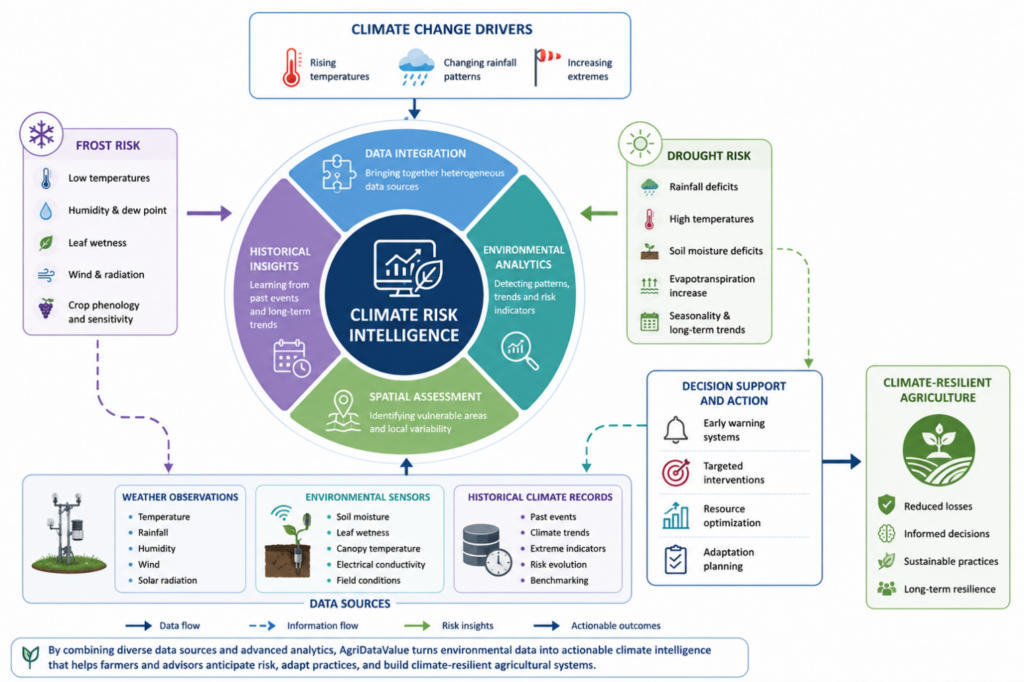
Within the AgriDataValue project, innovative data-driven methodologies are helping to address this challenge by combining sensor observations, climate records, and environmental indicators to improve the understanding and prediction of climate risks.
Looking Beyond Single Indicators
Agricultural systems are influenced by a wide range of environmental conditions that rarely operate in isolation. A damaging event is often the result of several factors acting together rather than a single threshold being exceeded. For example, frost damage is commonly associated with low temperatures. However, the severity of an event may also depend on atmospheric moisture, humidity levels, surface wetness, crop development stages, and local environmental conditions. Similarly, drought impacts are not determined solely by how much rain falls over the course of a year. Temperature increases, seasonal rainfall distribution, and soil moisture dynamics all play important roles in determining water availability for crops.
Recognizing these interactions is essential for improving risk assessment. By bringing together multiple sources of environmental information, it becomes possible to better understand the conditions that lead to crop stress and damage.
Combining Data to Better Understand Climate Risks
One of the key lessons emerging from recent analyses is that environmental data becomes significantly more valuable when different sources are considered together. Weather observations, sensor measurements, and historical climate records can each provide important insights on their own. However, when combined, they reveal relationships and patterns that would otherwise remain hidden. Accordingly, this integrated approach makes it possible to detect environmental conditions associated with increased climate risk, identify combinations of factors that contribute to crop vulnerability, understand how conditions evolve before a damaging event occurs, improve the accuracy of risk assessments and early warning systems and support more targeted and informed management decisions.
Rather than focusing on a single measurement, the methodology considers the broader environmental context in which agricultural production takes place.
Understanding Spatial Variability
Climate risks are rarely distributed evenly across agricultural landscapes.
Even within the same production area, environmental conditions can vary considerably due to differences in elevation, slope, exposure, soil characteristics, and local microclimates. As a result, some locations may consistently experience higher levels of risk than others.
Data analytics can help identify these patterns by analysing observations collected across multiple monitoring points. This makes it possible to distinguish areas that are repeatedly more vulnerable from those that are naturally more protected.
Such information is particularly valuable for farmers and land managers because it supports more precise interventions. Instead of applying the same measures everywhere, resources can be directed toward the locations where they are likely to have the greatest impact.
Learning from Historical Events
Historical climate records provide another important source of knowledge.
By analysing past events and comparing them with current environmental conditions, it becomes possible to identify recurring patterns and better understand how risks develop over time. This allows decision-support systems to recognise situations that resemble previous damaging events and provide earlier indications of potential problems.
The approach is particularly relevant in the context of climate adaptation. As more data becomes available, historical knowledge can be continuously enriched, enabling more robust risk assessments and improving the ability to anticipate future events.
Revealing Long-Term Climate Trends
In addition to supporting the detection of short-term hazards, integrated data analysis can also help identify long-term changes in climate behaviour.
Recent assessments have highlighted several important trends affecting agricultural systems:
- – Increasing average temperatures;
- – Greater variability in rainfall patterns;
- – More frequent periods of water stress;
- – Longer and less predictable drought seasons;
- – Greater occurrence of compound climate risks.
These findings demonstrate that climate vulnerability is influenced not only by individual extreme events but also by gradual changes that accumulate over time.
Understanding these trends is essential for designing effective adaptation strategies and ensuring the long-term resilience of agricultural production systems.
From Data Collection to Decision Support
The value of agricultural data lies not simply in collecting information but in transforming that information into knowledge that can support decision-making.
By integrating environmental observations, climate indicators, historical records, and analytical methods, it becomes possible to move from reactive responses toward more proactive risk management. Farmers, advisors, and agricultural organisations can gain a clearer understanding of emerging threats and take action before impacts become severe.
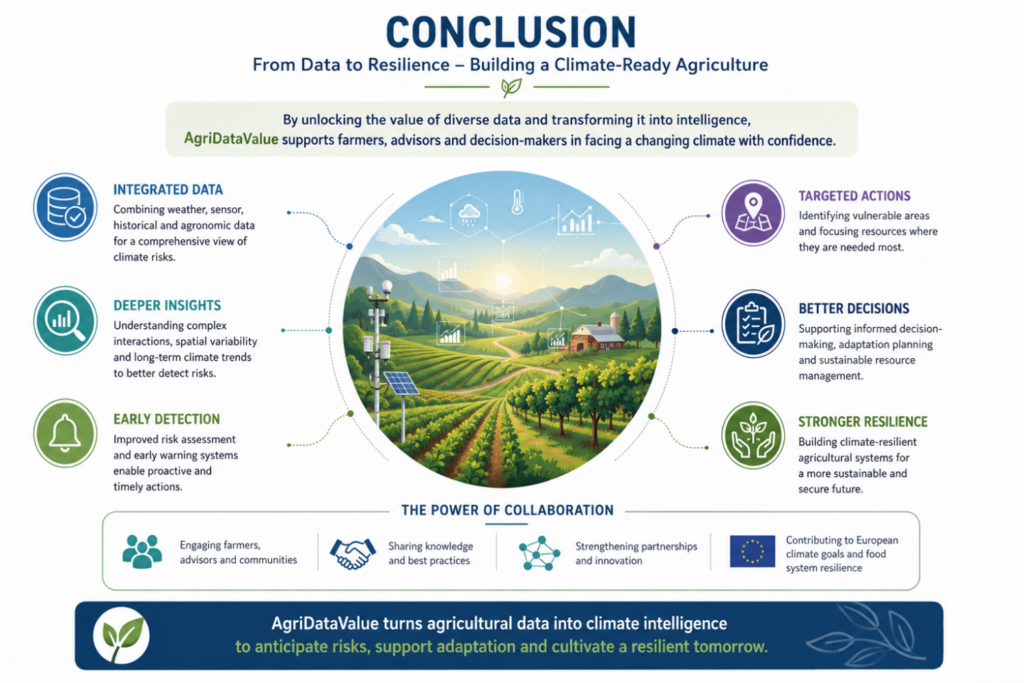
This transition from data collection to climate intelligence is a key objective of AgriDataValue. By unlocking the value of diverse data sources, the project contributes to the development of practical tools that support resilience, sustainability, and informed decision-making across the agricultural sector. The work carried out within AgriDataValue demonstrates that combining environmental data, climate information, and advanced analytics can provide a deeper understanding of agricultural vulnerability and support more effective adaptation strategies.
By turning data into actionable intelligence, these approaches help pave the way toward more resilient, sustainable, and climate-ready agriculture.