From Data to Trusted Data
Modern agriculture and food supply chains generate vast amounts of digital information. Sensors, farm management systems, laboratory analyses, logistics platforms and Artificial Intelligence models continuously produce great quantities of data that can improve productivity, sustainability and decision-making. One important aspect that is also a critical challenge in data governance can be summarized in one question: how can stakeholders trust that this information is authentic, has not been altered, and can be shared reliably across organizations and platforms? The AgriDataValue project (ADV) addresses this challenge by developing trusted and interoperable agricultural data ecosystems. Within this framework, the CHAINTRACK component leverages Blockchain technologies to support data certification, supply-chain traceability and interoperability across distributed systems. In this sense CHAINTRACK provides a technological foundation for data certification, supply-chain traceability and interoperability across distributed systems.
Building a Trusted Blockchain Infrastructure
The cornerstone of this trust framework is the implementation of a dedicated private Blockchain environment. It is based on an Ethereum-compatible architecture using a Proof-of-Authority (PoA) network with validator nodes and RPC nodes deployed through Kubernetes and Helm technologies. The architecture also supports several Blockchain platforms technologies, such as Ethereum, Polygon, Quorum and Avalanche.
Enhancing Supply-Chain Traceability
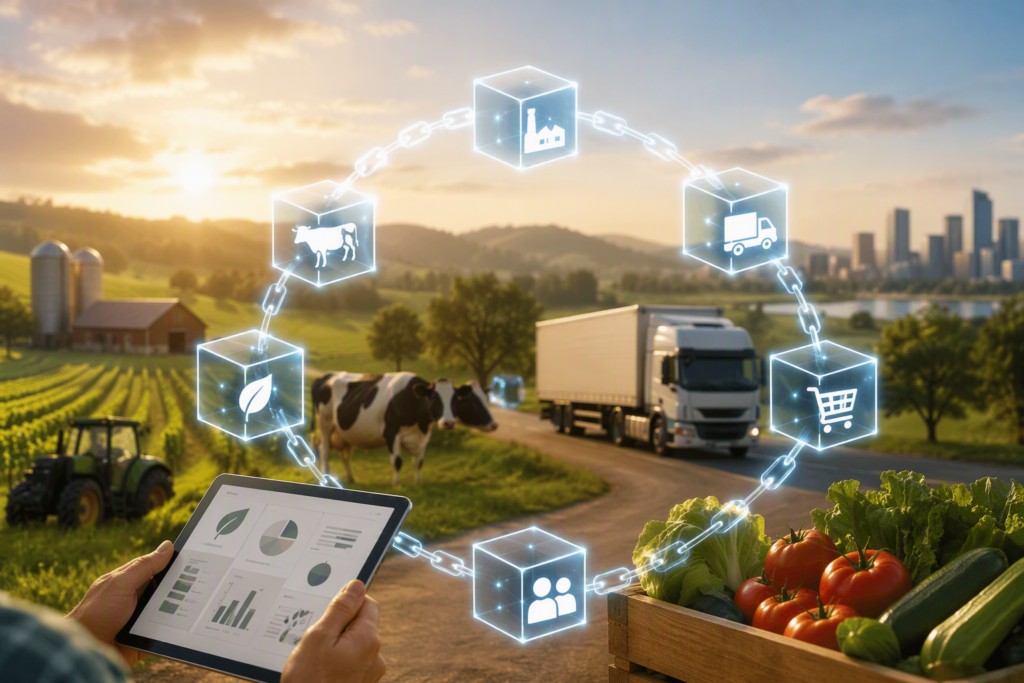
One of the most tangible applications of the ADV distributed ledger technology is supply-chain tracking. CHAINTRACK has implemented dedicated smart contracts and backend services designed to support traceability processes across agriculture chains. This allows creation of dedicated supply chains for specific user processes in relevant domains of activities. As for today, two of them have been produced, for meat and olive oil processes tracking. Through DLT-based recording mechanisms, stakeholders can create verifiable evidence that specific information existed at a given point in time. This approach can strengthen confidence in provenance data, processing records, quality certifications and other critical supply-chain information. Importantly, the system does not simply store business information. It combines business processes, databases and Blockchain certification procedures, creating an auditable trail that can be independently verified.
Supporting Trustworthy Artificial Intelligence
Another noteworthy innovation is the realization of an AI Model notarization capability. CHAINTRACK provides dedicated functionality for certifying trained AI models on Blockchain infrastructures. As Artificial Intelligence becomes increasingly important in agriculture, for example in predictive analytics, crop monitoring, decision support and sustainability assessments, the governance of AI models is emerging as a critical topic. Stakeholders require mechanisms to verify that deployed AI models are authentic, untampered and correspond to approved versions. Blockchain-based notarization can contribute to these objectives by creating transparent records of model versions, digital fingerprints and related metadata. While distributed ledger technology is not a replacement for AI governance frameworks, it can serve as a complementary technology supporting transparency, integrity verification and reproducibility.
Generalized Data Notarization
CHAINTRACK AI notarization capability has been extended to support notarization of any digital asset (such as datasets, digital documents, contracts and others) that has been written in the ADV secure storage layer. This capability is highly relevant for data-driven agriculture, where trust in datasets is becoming increasingly important. Research organizations, technology providers, cooperatives and public bodies frequently exchange data whose provenance and integrity must be guaranteed. Blockchain-based notarization can provide an additional layer of confidence and security.
Inter-DLT Interoperability
One of the most forward-looking aspects added in CHAINTRACK is the strong focus on interoperability, declined in the domain of Blockchain services. Interoperability is often cited as one of the most important challenges for digital transformation in agriculture. Farmers, industry stakeholders, technology providers and public authorities typically operate independent systems that must exchange information securely and efficiently. CHAINTRACK tackles this challenge by exploring mechanisms capable of operating across multiple Blockchain environments. The available Inter-DLT functionalities enable cooperation with both external DLT ecosystems as well as with other instances of the ADV platform.
Looking Ahead
The available ADV Blockchain-based functionalities demonstrate how distributed ledger technologies can support trusted digital agriculture by providing a practical framework for enhancing trust in agriculture data ecosystems. As Europe continues to promote data-driven innovation, sustainability and digital sovereignty in agriculture, solutions that guarantee transparency, integrity and interoperability will become increasingly valuable. The ADV DLT infrastructure represents an important contribution to this vision, showing how trusted digital infrastructures can help transform raw data into reliable assets that support collaboration, innovation and value creation across the entire agricultural sector.