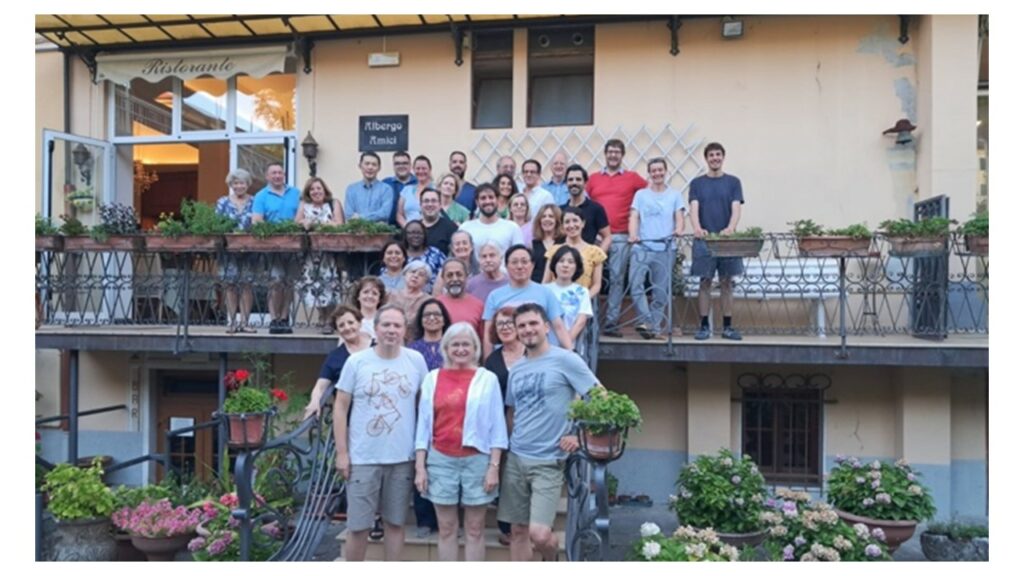
In July, the University of Lodz team presented the AgriDataValue project at the 33rd Colloquium of the International Geographical Union Commission on the Sustainability of Rural Systems, hosted by the University of Genoa.
This year’s theme, „Rural Systems in an Age of Local and Global Mobilities” brought together scholars from the Global North and South to discuss how flows of people, climate, capital and culture are reshaping rural areas. Presentation of the AgriDataValue project added one more flow to that map: the mobility of knowledge.
Karolina Dmochowska, Marcin Wójcik, Paulina Tobiasz-Lis and Patrycja Grzyś asked what happens to farming knowledge that was never written down. Fruit growers learn to read water stress in a leaf, a crack in the soil or the colour of the sky over decades of apprenticeship in one place. As Europe’s farm population ages and young people move to cities, that chain is breaking, and a lifetime of know-how can disappear when a grower retires.
At Wiatrowy Sad near Głowno (Poland), one family has been growing apples for more than 60 years. There is no irrigation on these rolling moraine slopes, so knowing when trees are running short of water has always depended on the grower’s eye and memory of past seasons. In AgriDataValue, the UniLodz team is working with the orchard to translate that judgement into data: a weather station and soil-moisture probes feed a machine-learning model that forecasts water-stress risk before the trees show it, and explains why. The aim is not to automate the grower’s intuition but to give it a form that can outlast one working life and be shared with the next generation.
The teams’s central argument is that explainable AI should work as a dialogue between generations, not as a replacement for the experienced grower. The algorithm needs the grower’s validation, and the grower gains a language that can be passed on to young and returning farmers.
This is a starting point, not a closed result. Over the next three growing seasons (2026–2028), the researchers will study what is gained and lost when tacit knowledge becomes explicit, whether young farmers actually adopt it, whether explainable AI builds more trust than black-box tools, and who risks being left behind by the digital divide.
Many thanks to the organisers at the University of Genoa and to everyone who joined the discussion!