As a partner of the AgriDataValue project, BioRo (Asociatia Operatorilor din Agricultura Ecologica Bio Romania) plays a vital role in advancing sustainable and organic farming through digital innovation.
Based in Romania, BioRo is a non-profit, non-governmental organization that represents over 10,000 members. In the context of AgriDataValue, BioRo acts as a key end-user and pilot partner, helping to bridge the gap between cutting-edge data technology and practical organic farming.
When BioRo started the pilot within the AgriDataValue project, the goal seemed simple: to use irrigation water more efficiently. In reality, this meant learning how to “listen” to the field and make decisions based on what it reveals day by day.
Within the pilot activities, BioRo is working on two plots—146A and 1470—where two different approaches were tested. On one plot, a conventional plowing system was followed, while on the other, minimum tillage and strip-till practices were implemented. Irrigation is carried out in the same way on both plots, using sprinkler systems with linear installations supplied from an open canal. The real difference, however, lies not only in soil management, but also in how data is used.
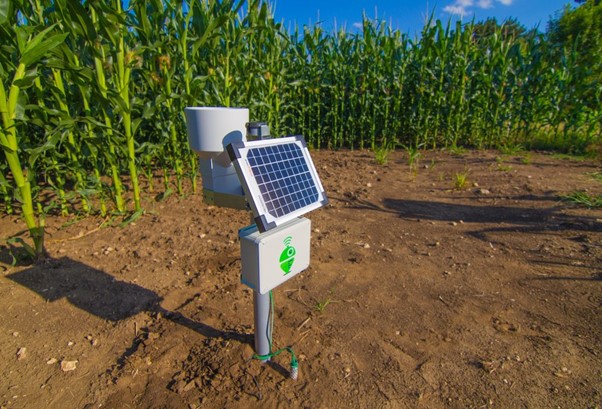
BioRo installed two weather stations that have gradually become some of the most important tools in this pilot. They do more than simply collect data on temperature, humidity, precipitation, and soil conditions—they provide context. In practice, they help the team understand what is happening at any given moment, rather than reacting afterward.
One of the most valuable insights gained through the pilot relates to precipitation. Instead of treating rainfall as a generic event, BioRo can now see exactly how much water reaches the soil, how it is distributed, and what impact it has on the crop. There are times when the decision not to irrigate is just as important as irrigating—and the data provides the confidence needed to make that decision.
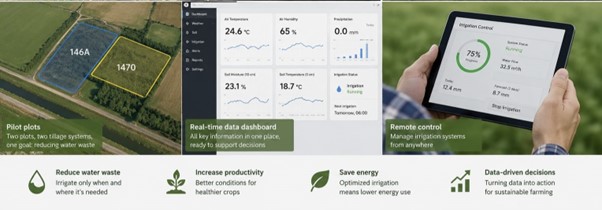
Soil moisture monitoring is equally important. In the past, decisions were based largely on experience and estimation. Now, BioRo can clearly assess whether there is enough water for germination or nutrient uptake, how deeply water has infiltrated after rainfall, and, most importantly, when irrigation is truly needed.
Soil and air temperature measurements complete the picture. They help identify the right timing for field operations, detect frost risks, and better understand conditions that may favor disease development. Daily temperature variations—morning, noon, and evening—also become relevant when optimizing every intervention.
Another key aspect is that all this data is available in real time and can be integrated into control systems. This opens the door to automation—not just collecting data, but acting on it in a consistent and efficient way.
For BioRo, this pilot is not only about technology. It is about changing how decisions are made in agriculture. The transition is moving from “this is how it’s usually done” to “this is what the data shows is better.”
As the project approaches its final stage, it is becoming increasingly clear that the answers being sought are not always simple—but they are within reach. With each season, BioRo gains a better understanding of the balance between water, soil, and crop performance, helping reduce waste and use resources more responsibly.